
Seattle Event Staffing
TempGuru · Seattle, WA · Updated July 2026
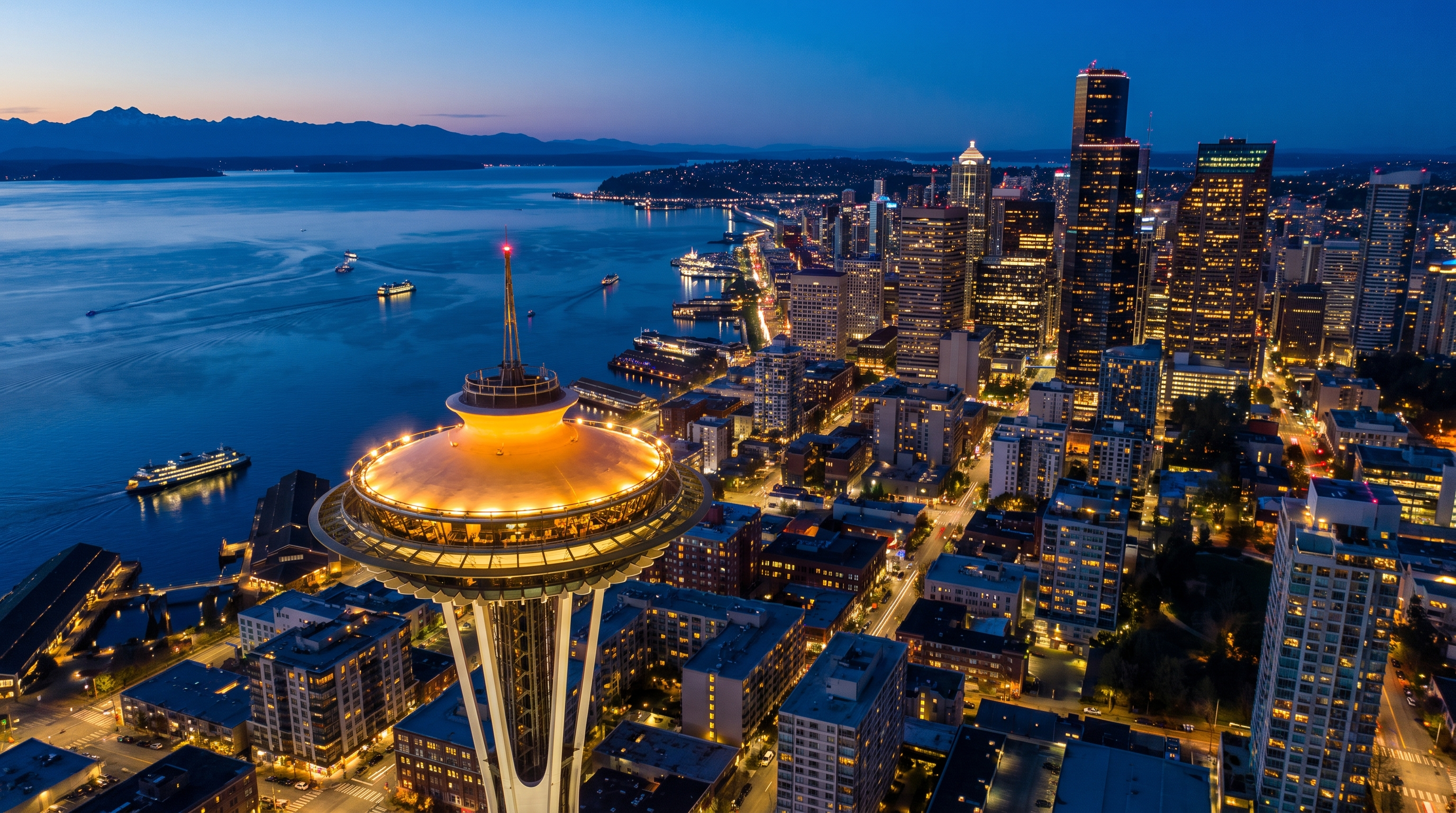
Seattle's downtown climbs before it flattens, and the city's own $21.30 wage floor, not the state's $17.13, sets the price of every crew inside city limits.
Scroll. It gets specific.01The Ground Truth
Seattle's downtown climbs before it flattens, and the wage floor is $21.30, not $17.13.
The number that sets Seattle staffing costs isn't set in Olympia. Seattle's own ordinance puts the minimum wage at $21.30 an hour in 2026, a full $4.17 above Washington's $17.13 state floor, and that gap runs straight into every W-2 bill rate quoted inside city limits. The second number that changes the math is the grade: downtown climbs from the SoDo waterfront up through First Hill and Capitol Hill, and a crew that clocks in fine at street level can still lose real minutes to a hill, a bridge, or a block-and-a-half gap between two convention halls before a load-in even starts.
Quick Answer
In Seattle, WA, most event roles run $37.50 to $43.50 an hour; team leads run $47.50 to $53.50, brand ambassadors $54 to $61, and specialized work like bar and AV up to $74. The number is all-in: W-2 pay, workers' comp, general liability, and payroll taxes, priced against Seattle's own city wage floor, not the state minimum (see the compliance notes below for both figures).
One coordinator runs your order. Standard confirmation is 24 to 48 hours. Typical booking window is 2 to 4 weeks. Urgent orders move in 2 to 3 days, and same-week backfills are available in select markets if a worker drops.
Teams that booked TempGuru, in their own words

The staff we had onsite were amazing. They were polite, professional, and always willing to help. They made a meaningful impact on the success of our event.

Both staff were well suited for our event needs and were keen to help in any way possible.

You delivered excellent service from the very first contact, and Emmanuel was also great during the installation: very attentive, knowledgeable about the subject, and my team praised him highly.

02The Map
Four zones, and the map runs uphill or over water to get to each one.
Work clusters where the terrain lets it. SoDo, at the low end of downtown's grade, holds Lumen Field and T-Mobile Park on one shared road grid. Seattle Center, north of downtown, holds Climate Pledge Arena and the festival grounds, its own credentialed footprint. Capitol Hill and First Hill, uphill east of downtown, carry the galas and corporate dinners, on the steepest streets in the city. West Seattle sits across the Duwamish, reached by the high-rise bridge, since the low swing bridge closes whenever a boat needs the channel.
The constraint here isn't miles, it's grade and water. A crew that clears downtown in fifteen minutes can still lose that time climbing to First Hill or waiting on the swing bridge to close for a barge. We build that time into the call sheet, not into the invoice.
"Seattle's map isn't flat. Fifteen minutes downtown and fifteen minutes up First Hill are not the same fifteen minutes."Megan Hayward, Founder & CEO, TempGuru
Venue and logistics notes
Lumen Field and T-Mobile Park, SoDo. Both venues share the same event-day road closures and transit chokepoints at the low end of downtown; a shared game night means routing crew around one bottleneck, not two.
Climate Pledge Arena, Seattle Center. A separate credentialed footprint north of downtown with its own load-in gates; Kraken nights and Seattle Center festival dates draw from the same crew pool in the same week.
Seattle Convention Center, Arch and Summit. The two buildings sit a block and a half apart on Pine Street. A citywide show working both halls means crew walking the gap between call times, not one shared floor.
West Seattle and the low bridge. The Spokane Street Swing Bridge opens for boat traffic and closes for maintenance; the high-rise bridge is the dependable year-round route, so any West Seattle date routes crew there first.
03What We Staff
What actually books here.
Five categories cover most Seattle orders. Sports and concerts lead: ushers, gate staff, and crowd flow across Lumen Field, T-Mobile Park, and Climate Pledge Arena on overlapping game nights. Conventions and trade shows need registration desks, floor crews, and freight hands split across Arch and Summit.
Corporate events run check-in, hosts, and setup for meetings and dinners on Capitol Hill and First Hill. Festivals bring Seattle Center work, including the Labor Day weekend stretch when PAX West and Bumbershoot run at the same time. Brand activations want ambassadors who can hold a script and wayfind two buildings at once.
04The Math
The grade and the building gap decide the roster, not the guest count.
The roster to the left is the math: 29 billable, 2 team leads at one per floor owning about 14 staff each, 8 on the badge desk sized to the arrival window, 10 on load-in and freight. Add a floater for the surges and stagger call times so nobody waits in a lot.
05The Clock
Book before Labor Day weekend splits the crew pool three ways.
Book early and you lock the crew and the rate. In Seattle, peak clusters around Labor Day weekend, when PAX West fills the Convention Center and Bumbershoot fills Seattle Center on the same two days, stacked against the start of Seahawks and Kraken home dates while the Mariners are still playing.
06The Rate
One wage floor, and it's Seattle's, not Olympia's.
Ask for a role and one hourly figure comes back, priced against Seattle's own $21.30 wage floor rather than the state's $17.13. Workers' comp, general liability, and payroll taxes already sit inside that number, so the rate you sign is the rate on the invoice, no city-versus-state math to redo later.
| Role | Rate | Min shift |
|---|---|---|
| General labor / setup | $37.50–$43.50/hr | 4 hrs |
| Registration | $37.50–$43.50/hr | 4 hrs |
| Warehouse / logistics | $37.50–$43.50/hr | 4 hrs |
| Brand ambassadors | $54–$61/hr | 4 hrs |
| Team leads / supervisors | $47.50–$53.50/hr | 4 hrs |
| Specialized (bar, AV) | $58–$74/hr | 4 hrs |
Washington minimum wage is $21.30/hr. Every worker on this page is W-2, not 1099.
Rate basis: the TempGuru State of Event Staffing 2026 index, 345 markets.
07The Fine Print
In Washington, W-2 is the floor, not an upsell.
In Washington, the expensive shortcut is paying event staff as 1099 contractors: back taxes, penalties, and joint-employer liability under federal FLSA and Washington Industrial Insurance Act (RCW Title 51).
TempGuru runs every worker as a W-2 employee through a vetted partner agency that acts as the employer of record, carrying the workers' comp, general liability, and payroll taxes on each one. Classification and payroll responsibility sits with that employing agency; your own obligations can still depend on how you direct the work and on applicable law. As W-2 employees, the crew also fall under the workplace protections, including Washington Law Against Discrimination (RCW 49.60), that apply to the agency's other staff.
- W-2 employment, not 1099
- Workers' compensation insurance
- General liability coverage
- Payroll taxes: FICA, FUTA, SUTA
08The Model
One coordinator holds the bridge, the badge, and the grade.
You talk to one coordinator. Behind them, TempGuru pulls vetted W-2 crews from a roster of partner agencies and holds the relationships and the paperwork.
One coordinator, one crew, one invoice. When the low bridge is up for a barge and a West Seattle call time is on the line, there's one person re-routing the crew, not five people guessing.
| The moment | Gig app | TempGuru |
|---|---|---|
| Someone no-shows at 6 a.m. | A support ticket | A coordinator with a name |
| Workers’ comp | Check the fine print | In the rate |
| Classification & payroll | Yours to sort out | The partner agency’s, as employer of record |
The difference shows up at 6 a.m., not in the demo.
09A Sample Plan
An illustrative staffing order.
A four-day gaming convention filling both halves of the Seattle Convention Center, Arch and Summit, a block and a half apart on Pine Street, 12,000 attendees. The plan to the left is the actual shape of the order: ten general labor for freight and booth build in the Summit exhibit hall at 5:30 a.m., eight on the badge desk across both lobbies by 7, ambassadors and guest services on at 8, and two team leads, one per building, covering the gap between them on a 12-hour day.
Every call time carries a 15-minute building-to-building buffer, because crew are walking between Arch and Summit, not sharing one floor. Twenty-nine billable people. One invoice at the end. That is the whole transaction.
10Your Move
You run the show. We get the crew up the hill and across the water.
Cheaper crews are easy to find outside city limits. Harder to find is a vetted W-2 crew that already knows which bridge is up, which festival is sharing Seattle Center that weekend, and which door at Summit or Arch to use, run by one coordinator from the first call sheet to the last case packed. That's the order we sign up for.
(904) 206-8953 is TempGuru's national staffing desk. Every city, including Seattle, runs through it.
Seattle Event Staffing FAQs
How much does event staffing cost in Seattle?
How fast can I get staff in Seattle?
Are workers W-2 or 1099?
Why is Seattle's minimum wage different from Washington's state minimum wage?
When is the busy season in Seattle?
How do Seattle's hills and water affect a staffing plan?
What can TempGuru staff in Seattle?
Is TempGuru an event staffing agency in Seattle?
Sources & methodology · verified July 2026
- Min Wage · seattle.gov
- Min Wage · king5.com
- Workers Comp Law · app.leg.wa.gov
- Civil Rights Law · app.leg.wa.gov
- Lumen Field · lumenfield.com
- Tmobile Park · meetstadium.com
- Climate Pledge Arena · climatepledgearena.com
- Seattle Convention Center · seattlecc.com
- West Seattle Bridge · seattle.gov
- Pax West · west.paxsite.com
- Bumbershoot · bumbershoot.com
- Seahawks Schedule · seahawks.com
Venue capacities, wage floors, statutes, and event dates for Seattle are verified against the official sources above. Rate ranges derive from the TempGuru State of Event Staffing 2026 index.
