
Phoenix Event Staffing
TempGuru · Phoenix, AZ · Updated July 2026
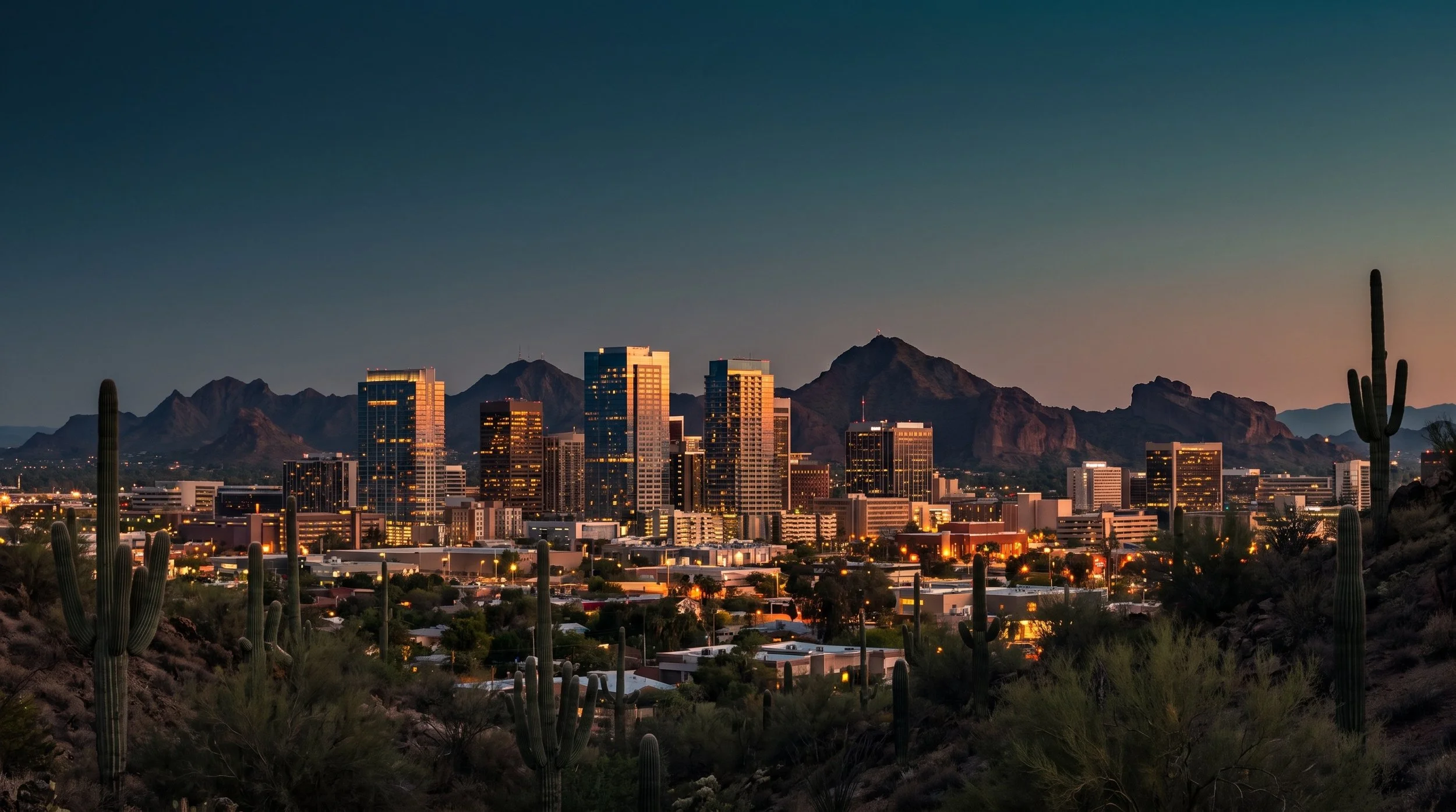
Staffing a desert metro where the thermometer sets the call time: summer load-ins start at dawn and move indoors, and winter runs from Cactus League fields to a Glendale stadium.
Scroll. It gets specific.01The Ground Truth
In Phoenix, heat writes the first line of every call sheet.
From May into September the desert sets the terms. Outdoor load-ins begin before sunrise, crews work a shade-and-water rotation, and the July monsoon can erase an afternoon with dust and rain, so summer business moves into the cooled bowls of Chase Field and Mortgage Matchup Center. Finding people is never the constraint. Managing the heat and the Valley's freeway spread is, and both belong on the call sheet before anyone counts heads.
Quick Answer
In Phoenix, AZ, most event roles run $37.50 to $43.50 an hour, team leads $47.50 to $53.50, and specialized crew like bartenders, AV techs, and brand ambassadors $54 to $74. Each figure is the full bill rate, with W-2 wages, payroll taxes, workers' comp, and general liability already folded in. Phoenix prices above our other markets, and the reason is on the ground: heat operations in summer and a winter where every date competes for the same crew.
You brief one person and that person carries the order start to finish. A standard request is confirmed within 24 to 48 hours, most events lock two to four weeks out, and a rush can be turned in two to three days for a premium. For Cactus League weeks and a big-game Sunday at State Farm Stadium, reserve months ahead, because the crew pool tightens fast.
Teams that booked TempGuru, in their own words

The staff we had onsite were amazing. They were polite, professional, and always willing to help. They made a meaningful impact on the success of our event.

Both staff were well suited for our event needs and were keen to help in any way possible.

You delivered excellent service from the very first contact, and Emmanuel was also great during the installation: very attentive, knowledgeable about the subject, and my team praised him highly.

02The Map
Three clusters, one heat plan, and the freeway in between.
Downtown Phoenix is the cooled core: the Phoenix Convention Center, Chase Field, and Mortgage Matchup Center sit within a few walkable blocks, tied together by the light rail. When July arrives, this is where business goes to stay in air conditioning. Glendale's Westgate district, a twenty-minute run northwest on the I-10 and Loop 101, holds State Farm Stadium and Desert Diamond Arena in a single entertainment strip. Scottsdale and the East Valley carry the resort galas, golf-week hospitality, and the Tempe and ASU crowd.
Two forces shape every plan, and heat is the first. From May into September an outdoor call time gets pulled back to dawn, and each sheet lists shade points, water drops, and a rotation so nobody stands in the sun too long. The July to September monsoon adds dust walls and flash downpours, so any outdoor date carries a backup indoors. Distance is the second force: put a crew downtown and in Glendale on the same day and the freeway eats the middle of it, so we time the calls to the drive, not the doors.
"In Phoenix the first question is not who works the event. It is how hot it will be when they clock in, and whether the show should be inside by then."Megan Hayward, Founder & CEO, TempGuru
Venue and logistics notes
Phoenix Convention Center, downtown. Close to a million square feet with garages and a light-rail stop at the door. Dock deliveries and exhibit build get the earliest calls so the heavy lifting finishes before the afternoon heat, and the cooled halls make it a summer-safe booking.
Chase Field and Mortgage Matchup Center, downtown. Both run under climate control, which is why so much summer business lands here. Chase Field closes its roof for Diamondbacks day games, Mortgage Matchup Center holds Suns nights and concerts, and only the load-in dock and the entry queue outside still feel the 108 degrees.
State Farm Stadium, Glendale. The Westgate marquee twenty minutes northwest, home to Super Bowls, the College Football Playoff, and Final Four weekends. Acres of surface parking help, but credentialed gates and freeway egress mean a staged, early call built around the lot pour.
Desert Diamond Arena and Westgate, Glendale. Next door to the stadium, the arena and the Westgate blocks run concerts and brand activations. Anything outdoors from July into September gets a shade plan and a monsoon backup written in before the date is confirmed.
03What We Staff
Winter carries the load, and summer moves it inside.
Sports and concerts set the pace. The Cactus League drops fifteen teams and their crowds across the Valley every February and March, the Suns and Diamondbacks keep downtown busy, and a big-game Sunday at State Farm Stadium pulls a national gate. Conventions and trade shows fill the Phoenix Convention Center through the cool months, when the rest of the country wants to meet somewhere warm.
Corporate and resort work runs deep in Scottsdale, where golf-week hospitality and desert-resort incentives ask for polished floor and bar staff. Festivals and brand activations round out the year, weighted to October through April, with the summer dates either starting at dawn or moving under a roof.
04The Math
Build the roster around the heat, then the headcount.
The roster to the left is built around gates, not seats: 39 billable, 3 team leads on the floor at about 12 staff each, ushers and crowd control scaled to the doors-open surge. Stagger call times around the security screen so crew clear the perimeter before the rush, not during it.
05The Clock
Lock winter early, because the whole Valley locks it at once.
Book early and you lock the crew and the rate. In Phoenix the calendar inverts with the temperature. October through April is peak, when Cactus League baseball, big-game Sundays at State Farm Stadium, and back-to-back convention and resort weeks compete for crew. Summer flips the model, pushing outdoor dates to dawn and steering the rest into the cooled bowls downtown.
06The Rate
One number per role, heat plan and all.
Each role comes back as a single bill rate, so you price the event once instead of stitching together quotes from three vendors. Payroll taxes, workers' comp, and general liability already sit inside that rate. Phoenix reads a little higher than our other markets for two grounded reasons: summer heat operations, and a winter where every date wants the same crew.
| Role | Rate | Min shift |
|---|---|---|
| General labor / setup | $37.50–$43.50/hr | 4 hrs |
| Registration | $37.50–$43.50/hr | 4 hrs |
| Warehouse / logistics | $37.50–$43.50/hr | 4 hrs |
| Crowd control / ushers | $37.50–$43.50/hr | 4 hrs |
| Team leads / supervisors | $47.50–$53.50/hr | 4 hrs |
| Specialized (bar, AV, ambassadors) | $54–$74/hr | 4 hrs |
Arizona minimum wage is $15.15/hr. Every worker on this page is W-2, not 1099.
Rate basis: the TempGuru State of Event Staffing 2026 index, 345 markets.
07The Fine Print
In Arizona, paying 1099 is the costly shortcut.
In Arizona, the expensive shortcut is paying event staff as 1099 contractors: back taxes, penalties, and joint-employer liability under federal FLSA and Arizona workers' compensation law.
TempGuru runs every worker as a W-2 employee through a vetted partner agency that acts as the employer of record, carrying the workers' comp, general liability, and payroll taxes on each one. Classification and payroll responsibility sits with that employing agency; your own obligations can still depend on how you direct the work and on applicable law. As W-2 employees, the crew also fall under the workplace protections, including federal Title VII, that apply to the agency's other staff.
- W-2 employment, not 1099
- Workers' compensation insurance
- General liability coverage
- Payroll taxes: FICA, FUTA, SUTA
08The Model
One coordinator who already moved the call to dawn.
You talk to one coordinator. Behind them, TempGuru pulls vetted W-2 crews from a roster of partner agencies and holds the relationships and the paperwork.
One coordinator, one crew, one invoice. When a July load-in slips at 108 degrees, one coordinator picks up, and the dawn call time and the water drops were already on the sheet before you noticed.
| The moment | Gig app | TempGuru |
|---|---|---|
| Someone no-shows at 6 a.m. | A support ticket | A coordinator with a name |
| Workers’ comp | Check the fine print | In the rate |
| Classification & payroll | Yours to sort out | The partner agency’s, as employer of record |
The difference shows up at 6 a.m., not in the demo.
09A Sample Plan
An illustrative staffing order.
Take a July concert at Mortgage Matchup Center, sixteen thousand five hundred people arriving after dark to dodge the worst of the day. The plan on the left is how it holds together, and it starts at five in the morning. Eleven on general labor build the stage and set barricade at the cooled dock before the sun turns the loading bay into an oven. By four in the afternoon the front-of-house crew clock in: twelve on crowd control for the floor rail and concourse, six on guest services running doors, ADA, and the water stations, seven behind the concourse and club bars. Three leads open at five with the load-in and stay through the last call, one lead to a level, all on one channel.
The heat is the reason for the shape. The bowl runs under air conditioning, so the crowd stays comfortable, but the loading dock and the doors line outside do not, which is why the sunrise calls carry shade breaks and cold water and the evening calls do not. Thirty-nine people, one crew, one invoice, and a coordinator who built the call order around the thermometer instead of the door count.
10Your Move
Your event, staffed against the forecast.
The cheap crew is easy to find. The hard version is a summer load-in that starts at dawn and finishes before the bay turns into an oven, a downtown show held indoors while it hits 110 outside, and a Glendale gate covered on a big-game Sunday, all W-2, all run by one coordinator from brief to breakdown. That is the order we sign up for.

Your Phoenix coordinator
Michelle Roberts
Michelle Roberts coordinates TempGuru's crews across the Southwest, West, and the corridor from Indiana to Texas. A retired Army Colonel, she has led staffing on TempGuru's military events.
(904) 206-8953 is TempGuru's national staffing desk. Every city, including Phoenix, runs through it.
Phoenix Event Staffing FAQs
How much does event staffing cost in Phoenix?
How fast can I get staff in Phoenix?
Are workers W-2 or 1099?
How does Phoenix heat change an event plan?
When is the busy season?
What can TempGuru staff in Phoenix?
Is TempGuru an event staffing agency in Phoenix?
What is event staffing?
Sources & methodology · verified July 2026
- Min Wage · gblaw.com
- Workers Comp Law · azleg.gov
- Phoenix Convention · visitphoenix.com
- Mortgage Matchup Center · mortgagematchupcenter.com
- Mortgage Matchup · en.wikipedia.org
- Chase Field · en.wikipedia.org
- State Farm Stadium · statefarmstadium.com
- Karol G State Farm · statefarmstadium.com
Venue capacities, wage floors, statutes, and event dates for Phoenix are verified against the official sources above. Rate ranges derive from the TempGuru State of Event Staffing 2026 index.
