
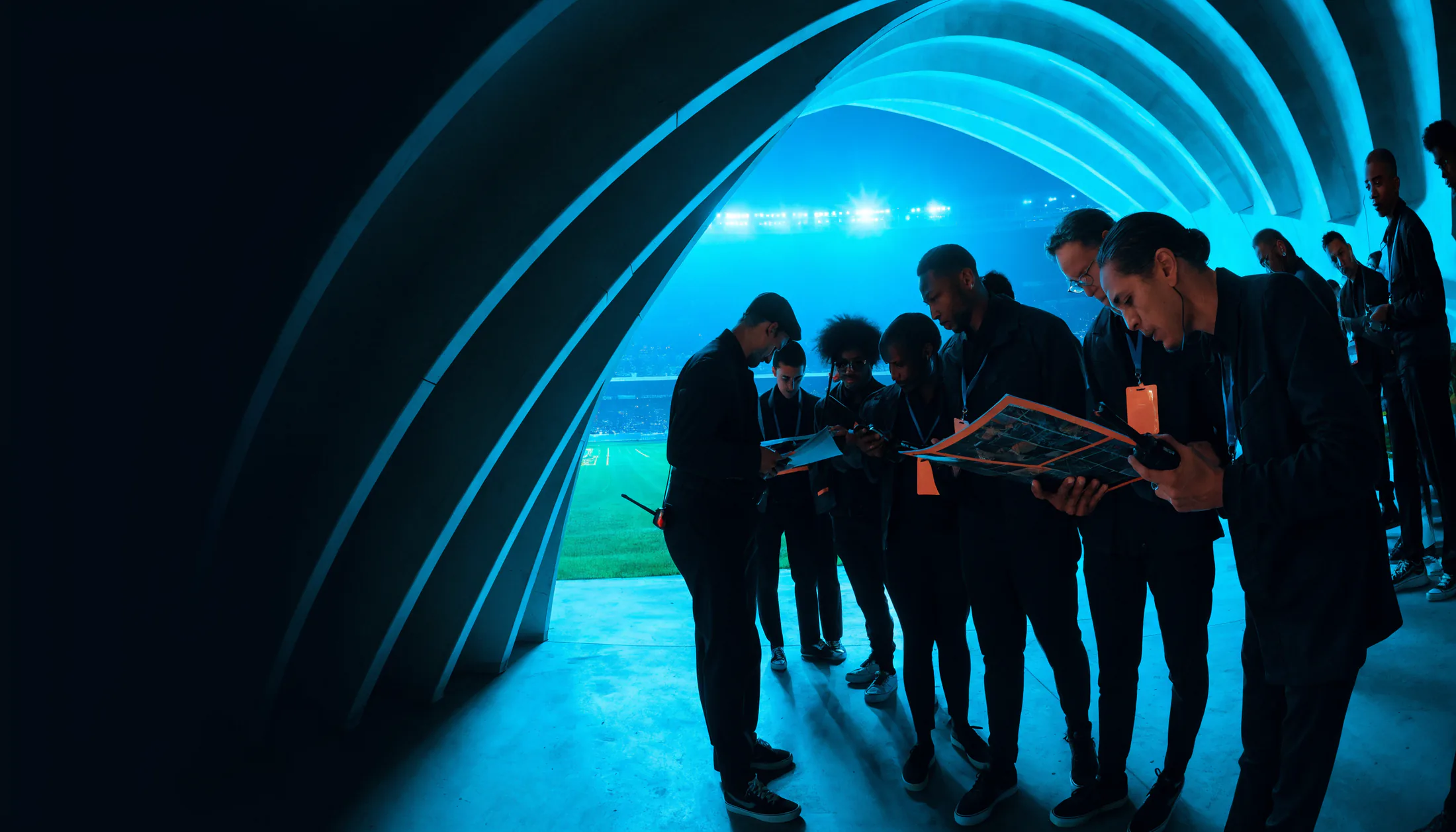
How To Staff a Stadium Event
Stadium Event Staffing Guide: Zone-Based Deployment, Roles, Ratios & Budget
The operations playbook for staffing stadium events from 10,000 to 80,000+ capacity — covering zone mapping, role matrices, compliance, and budget frameworks used at venues like SoFi Stadium, AT&T Stadium, and MetLife Stadium.
Stadium events operate at a scale that exposes every weakness in your staffing plan. When 40,000 people arrive within a 90-minute window, flow through 200+ concession points, fill three tiers of seating, and exit in a 30-minute crush — the margin for staffing error is essentially zero. Understaffed gates create dangerous bottlenecks. Understaffed concourses lead to crowd control incidents. Understaffed parking turns a 20-minute exit into a two-hour gridlock.
Whether you're staffing NFL games at SoFi Stadium, college football at Michigan Stadium or Ohio Stadium, concerts at AT&T Stadium, or multi-day events at MetLife Stadium, the fundamentals are the same: zone-based workforce deployment, role-specific hiring, and airtight compliance. This guide covers the full stadium staffing operation from venue assessment through post-event optimization.
Staffing a stadium event in multiple markets? TempGuru provides pre-vetted, W-2 compliant crews across 300+ cities with 24-48 hour confirmation.
Schedule a Call →Map Your Venue Zones and Calculate Staffing Density
Stadium staffing is fundamentally a logistics problem. Unlike open-format events, stadiums have fixed infrastructure — concourses, gates, sections, levels, suites — that dictate exactly where people will be and how they'll move. Your staffing plan needs to mirror this architecture.
| Zone | Description | Staffing Priority |
|---|---|---|
| Exterior gates | Ticket scanning, bag check, metal detection, ADA entry | Critical — controls ingress rate |
| Main concourse | Primary circulation, concessions, restrooms, info points | High — highest sustained traffic |
| Lower bowl seating | Sections closest to field/stage, premium positioning | High — dense and difficult to access |
| Upper bowl seating | Upper-level sections, steeper and harder to navigate | Medium — requires ADA-trained ushers |
| Suite/club level | Premium hospitality areas, private boxes, club lounges | Medium — lower volume, higher service |
| Field/floor level | Stage access, pit area, VIP floor seating, media | High — security-intensive, credentialed |
| Parking/transit | Lots, garages, shuttle zones, rideshare staging | High — pre- and post-event peaks |
| Back-of-house | Loading docks, vendor staging, staff break areas, command center | Low volume but operationally critical |
The National Fire Protection Association (NFPA) establishes occupancy load factors for assembly venues that inform minimum staffing. Beyond code compliance, operational staffing density should target a 1:40 staff-to-attendee ratio for full-service stadium events. High-traffic zones (gates, main concourse) should run closer to 1:25, while upper bowl sections can operate at 1:60.
A 40,000-seat stadium event typically requires 800 to 1,200 staff deployed across 8 to 12 operational zones.
Build Your Role Matrix by Zone
Every zone in a stadium has distinct role requirements. The mistake most organizers make is treating staffing as a flat headcount rather than a zone-by-zone deployment plan.
Exterior gates (highest ingress volume)
Gate staff handle ticket scanning, bag inspection, metal detection assistance, ADA patron support, and crowd queuing. The Department of Homeland Security's SAFETY Act framework influences security screening procedures at large venues. A single gate lane processes approximately 600 to 800 patrons per hour — so a 40,000-seat venue with 8 gates needs roughly 40 to 56 gate staff to achieve a 90-minute fill.
Seating sections
Section ushers scan tickets for seat verification, direct traffic flow, manage aisle clearance, and serve as the first point of contact for guest issues. The general guideline is one usher per section of 200 to 300 seats, with additional ushers at premium sections and ADA-accessible areas.
Suite and club level
Suite attendants provide white-glove hospitality service. Each suite typically requires one dedicated attendant, while club areas need 1 attendant per 40 to 50 guests. These roles command premium rates due to the service standard expected.
Concourse operations
Concourse monitors manage foot traffic, assist with wayfinding, and serve as a visible presence in high-traffic corridors. Concessions support staff supplement the venue's permanent food service team.
Parking and transit
Lot attendants direct vehicle flow, manage accessible parking, and coordinate with shuttle or rideshare staging areas. The Institute of Transportation Engineers (ITE) provides event traffic management guidelines that inform parking staffing ratios.
Command center
Every stadium event needs a staffing command center — a centralized hub where the staffing coordinator, zone supervisors, and venue operations can communicate in real time. This is where no-show replacements are dispatched, break schedules are managed, and zone-to-zone redeployments are coordinated.
Establish Your Procurement Timeline
Stadium events have a shorter ramp-up window than festivals because the venue infrastructure is fixed, but the sheer volume of staff required demands early planning.
For recurring events (sports seasons, concert series):
- 60 days before first event — Establish the staffing framework. Define zones, roles, headcount by position, and rate agreements.
- 45 days — Confirm leadership: staffing coordinator, zone supervisors, and any specialized roles requiring certifications.
- 21 days — Confirm all frontline staff. Your provider should have names, not just commitments.
- 7 days — Finalize credentials, site access passes, uniform distribution, and training schedules.
- 48 hours — Run final confirmation calls. Activate backup roster for any drops.
For one-off events: Add 30 days to each milestone. One-off events don't benefit from a returning crew, so lead times for recruitment and vetting are longer.
The Venue Managers Association of the Pacific reports that venues with 60%+ returning seasonal staff see 40% fewer guest complaints and 25% lower training costs.
Address Compliance, Licensing, and Insurance
Stadium events carry elevated compliance requirements because of the crowd density, the physical demands on workers, and the regulatory scrutiny that comes with large public gatherings.
W-2 classification is non-negotiable
The volume of workers, the degree of control exercised over their duties, and the structured scheduling make 1099 classification indefensible under the Department of Labor's economic reality test. Your staffing provider should employ all temporary workers as W-2 employees and handle payroll, withholding, and employer-side taxes (FICA, FUTA, SUTA).
Workers' compensation coverage
Must be active for every worker on-site. Stadium events involve standing for 8+ hours, lifting, navigating stairs in crowded conditions, and weather exposure. The National Council on Compensation Insurance (NCCI) classifies event staffing under codes that reflect these risk factors.
ADA compliance staffing
The Americans with Disabilities Act requires accessible seating, accessible entry points, and staff trained to assist patrons with disabilities. Your staffing plan should include dedicated ADA-trained personnel at every entry gate and in every seating zone with accessible sections.
Alcohol service and background checks
States regulate server-to-patron ratios and require certifications. Staff with access to restricted areas — suites, field level, back-of-house, media areas — typically require background screening. Your provider should handle this as part of the credentialing process.
Build Your Stadium Staffing Budget
Stadium staffing budgets are driven by three variables: venue capacity, event complexity, and market rates.
| Role Tier | Hourly Rate | Typical Deployment |
|---|---|---|
| Gate staff / general ushers | $22 – $30/hr | Highest volume, 60% of headcount |
| Concessions / parking | $24 – $32/hr | Second-tier volume |
| Suite attendants / VIP hosts | $28 – $38/hr | Premium service, lower volume |
| ADA / credential managers | $32 – $45/hr | Certified, lower volume |
| Zone supervisors | $38 – $48/hr | 1 per zone |
| Staffing coordinator | $45 – $55/hr | 1 per event |
A typical single event at a 40,000-seat venue runs $80,000 to $180,000 in staffing costs. Pre-event setup accounts for roughly 10% of the budget, event-day operations absorb 70%, post-event teardown takes 10%, and the remaining 10% should sit in contingency for overtime, weather-related extensions, and last-minute additions.
Venues running 40+ events per year should negotiate season-long rate agreements. Volume commitments typically yield 8 to 15 percent rate reductions versus per-event pricing, and the returning crew benefit compounds the value.
Deploy and Manage on Event Day
Stadium event-day operations are a choreographed sequence. Every phase has distinct staffing requirements.
Pre-gates (T-minus 4 to 6 hours)
Setup crews arrive for staging, signage deployment, checkpoint assembly, and equipment checks. The staffing coordinator confirms headcount against the roster and identifies any gaps requiring backup activation.
Gates open (T-minus 90 minutes to event start)
This is the highest-stress staffing period. All gate staff, ushers, parking attendants, and concourse monitors must be at their posts before the first patron enters. According to the International Association of Assembly Managers, the ingress period accounts for 60% of all guest experience complaints at stadium events.
During event
Shift to crowd monitoring, concessions support, and incident response. The roving reserve team (10 to 15 staff) is available for redeployment to emerging hotspots. The command center tracks real-time data: which gates are at capacity, which concession points have long queues, which sections are reporting issues.
Egress (event end + 60 minutes)
The most dangerous phase from a crowd safety perspective. All ushers, concourse monitors, and gate staff switch to egress support. The Centre for Crowd Management and Security Studies research shows that well-staffed egress reduces exit time by 30 to 40 percent and significantly lowers crush risk.
Post-event (T-plus 2 to 4 hours)
Teardown crews handle cleanup, equipment recovery, and venue restoration. A final walkthrough with the venue operations team confirms the space is returned to standard.
Run Post-Event Analysis
Stadium events generate enough data to significantly improve your staffing model for future events — if you capture it.
Data points to collect:
- Zone-level headcount vs. plan — which zones were overstaffed? Understaffed?
- Gate throughput rates — did ingress meet your target fill time?
- No-show and late-arrival rates — by zone and by provider, if using multiple agencies.
- Overtime hours by zone — planned vs. unplanned. Unplanned overtime signals a forecasting gap.
- Incident density by zone — correlate incident reports with staffing levels to identify causation.
- Guest satisfaction signals — complaints, social media sentiment, venue operator feedback.
The best stadium operators run this analysis after every event and make incremental adjustments. Over a season, these marginal improvements compound into significantly better operations and lower per-event costs.
Sports vs. Concerts: How Staffing Differs at the Same Venue
The same 65,000-seat stadium requires fundamentally different staffing plans depending on whether it's hosting an NFL game or a concert tour stop. Understanding these differences prevents the most common mistake in stadium staffing: applying a one-size-fits-all model.
| Variable | Sports Event | Concert |
|---|---|---|
| Floor/field access | Restricted to credentialed personnel only | GA floor, pit, VIP packages — requires pit security and barricade monitors |
| Crowd energy arc | Peaks at game-changing moments, distributed across quarters/halves | Builds continuously, peaks at headliner, high sustained energy |
| Egress pattern | Staggered (some fans leave early) | Compressed — 90%+ leave within 30 minutes of encore |
| Concessions timing | Spread across halftime and breaks | Concentrated during set changes |
| Merch staffing | Minimal — team stores are venue-operated | High — touring merch needs dedicated support crews |
| Production support | Minimal load-in/load-out | Major — 8-12 hour load-in, 4-6 hour load-out |
| Additional staff needed | +0% baseline | +15-25% over sports baseline for GA shows |
Venues that run both sports and concerts should maintain two staffing templates. Concert conversions at venues like AT&T Stadium or MetLife Stadium typically require 15 to 25 percent more staff than a regular-season game at the same venue, plus specialized roles (pit security, barricade monitors, artist liaison) that don't exist in the sports template.
Entry Throughput Math: How to Size Your Gate Operation
Gate throughput is the single most measurable staffing variable at a stadium event. Get it wrong and you create dangerous bottlenecks. Get it right and ingress becomes your competitive advantage for guest experience.
The fundamental unit is: 1 scanner = approximately 700 guests per hour through a single lane. This accounts for ticket scanning, bag check delays, ADA accommodations, and the natural variance in arrival patterns.
| Venue Capacity | Target Fill Time | Scanner Lanes Needed | Gate Staff (Total) |
|---|---|---|---|
| 10,000 | 60 min | 15 lanes | 30 – 40 |
| 25,000 | 75 min | 24 lanes | 50 – 65 |
| 40,000 | 90 min | 38 lanes | 80 – 100 |
| 65,000 | 90 min | 62 lanes | 125 – 160 |
| 80,000+ | 120 min | 70+ lanes | 150+ – 200+ |
The formula: (Venue capacity ÷ target fill time in hours) ÷ 700 = minimum scanner lanes. Then multiply by 2 for total gate staff (1 scanner + 1 bag check/queue manager per lane). Add 10-15% for ADA lanes, VIP express entry, and break coverage.
A 65,000-seat NFL game at MetLife Stadium with a 90-minute fill target: 65,000 ÷ 1.5 hours = 43,333 guests/hour needed. At 700 guests/lane/hour, that's 62 scanner lanes minimum. With support staff, ADA lanes, and break coverage, total gate operation runs approximately 140 to 160 personnel.
Emergency Operations and Evacuation Staffing
Every stadium staffing plan must include an emergency operations overlay. This isn't a separate plan — it's a protocol that activates on top of your existing zone structure.
Key principles:
- Every zone supervisor doubles as an evacuation leader. They know their zone's exit routes, assembly points, and ADA-assist requirements. This dual-role approach means you don't need a separate evacuation team — the zone leadership already in place activates the protocol.
- The command center becomes the emergency operations center. Your staffing coordinator and venue operations team are already co-located. In an emergency, communication switches from operational to emergency channels.
- Gate staff reverse direction. The same personnel managing ingress become egress facilitators. Their familiarity with gate infrastructure, crowd flow patterns, and ADA entry points makes them the most effective emergency egress staff.
- Roving reserve deploys to incident zones. Your 10 to 15 person reserve team — already positioned for operational flexibility — becomes the rapid response unit for medical, security, or crowd management emergencies.
Evacuation time benchmarks:
| Venue Capacity | Full Evacuation Target | Staff Required for Evacuation |
|---|---|---|
| 10,000 | 8 – 12 minutes | 100% of on-duty staff |
| 40,000 | 15 – 20 minutes | 100% of on-duty staff + venue security |
| 80,000+ | 20 – 30 minutes | 100% of on-duty staff + venue + mutual aid |
The NFPA 101 Life Safety Code establishes maximum evacuation time standards for assembly occupancies. Your staffing plan should demonstrate that you can meet these standards with your deployed workforce.
Stadium Staffing Quick Reference
| Venue Capacity | Total Staff | Gate Staff | Ushers | Concourse | Suites/VIP | Parking | Supervisors |
|---|---|---|---|---|---|---|---|
| 10,000 | 200 – 280 | 25 | 50 | 30 | 20 | 25 | 8 |
| 25,000 | 500 – 700 | 50 | 120 | 70 | 50 | 60 | 16 |
| 40,000 | 800 – 1,200 | 80 | 200 | 120 | 80 | 100 | 24 |
| 65,000 | 1,300 – 1,800 | 120 | 320 | 180 | 120 | 150 | 35 |
| 80,000+ | 1,600 – 2,200+ | 150+ | 400+ | 220+ | 150+ | 180+ | 45+ |
Key Takeaways
- Use zone-based staffing models — flat headcount planning fails at stadium scale.
- Target a 1:40 staff-to-attendee ratio for full-service operations, with 1:25 in high-traffic zones.
- Start 60 days out for recurring events, 90 days for one-off events.
- All staff must be W-2 classified with active workers' compensation coverage.
- Budget $22 to $55 per hour depending on role tier, with 10% contingency reserve.
- Size gate operations using the 1-scanner-per-700-guests-per-hour formula.
- Concerts at stadiums need 15-25% more staff than sports events at the same venue.
- Every zone supervisor doubles as an evacuation leader — build emergency ops into the existing structure.
- Operate a centralized command center with real-time zone reporting.
- Build a returning crew — it's the single biggest ROI driver for recurring venues.
Frequently Asked Questions
How many staff do I need for a stadium event?
▼Stadium events typically require a 1:40 staff-to-attendee ratio for full-service operations. A 40,000-seat stadium event needs approximately 800 to 1,200 staff including gate operations, ushers, concessions support, suite attendants, parking, security, and command center personnel. The ratio increases for events with complex logistics like concerts or multi-act shows.
What is zone-based staffing for stadium events?
▼Zone-based staffing divides the stadium into distinct operational areas, each with its own staffing plan and chain of command. Typical zones include exterior gates, main concourse, upper and lower seating bowls, suite and club levels, field or floor level, parking lots, and back-of-house. Each zone has a supervisor and a dedicated headcount based on capacity and traffic patterns.
How far in advance should I staff a stadium event?
▼For recurring stadium events like sports seasons, begin 60 days before the first event to establish your staffing framework. For one-off events like concerts or special events, start 90 days out. Leadership roles should be confirmed at 45 days, frontline staff at 21 days, and all credentials and site access should be finalized 7 days before the event.
What does stadium event staffing cost?
▼Stadium event staffing rates range from $22 to $55 per hour depending on the role. General ushers and gate staff cost $22 to $30 per hour, concessions and suite attendants $28 to $35, specialized roles like ADA compliance and credential management $32 to $45, and supervisory positions $42 to $55 per hour. A single event at a 40,000-seat venue typically runs $80,000 to $180,000 in total staffing costs.
What compliance requirements apply to stadium event staffing?
▼Stadium event staff must be W-2 classified employees with workers' compensation coverage and general liability insurance. Requirements include state wage and hour law compliance, FLSA overtime rules, ADA accessibility staffing, alcohol service certifications, and background checks for staff accessing restricted areas.
Staff Your Stadium Event With Confidence
TempGuru provides pre-vetted, W-2 compliant event crews in 300+ cities. Zone-based deployment. Dedicated coordinators. Confirmed in 24-48 hours.