
New York City Event Staffing
TempGuru · New York City, NY · Updated July 2026
Staffing all five boroughs, where the crew is never the hard part -- the doors, the docks, the unions, and the transit map are.
Scroll. It gets specific.01The Ground Truth
In New York, the crew is the easy part. The doors are the job.
Five boroughs, thousands of available workers, and a labor market deeper than anywhere in the country. What decides a New York event is never headcount. It is access: which doors and docks you control, where the house unions take over, and how a crew with no parking actually reaches Midtown or Downtown Brooklyn on time.
Quick Answer
Across New York City, most event roles run $43 to $49 an hour. Team leads sit at $53 to $59, brand ambassadors at $59.50 to $66.50, and specialty work such as bartending and AV reaches $79.50. Each figure is all-in: W-2 pay, payroll taxes, general liability, workers' comp, and the coordinator, quoted as one number before you sign.
One coordinator carries the order from the first brief, never a phone tree. Most New York dates settle 2 to 4 weeks out, a placed order confirms in 24 to 48 hours, and a genuine rush puts crew on site in 2 to 3 days at a premium. The catch is the calendar: when Fashion Week, a Javits marquee show, or a Garden run lands, the credentialed pool commits early, so give those the longest runway you can.
Teams that booked TempGuru, in their own words

The staff we had onsite were amazing. They were polite, professional, and always willing to help. They made a meaningful impact on the success of our event.

Both staff were well suited for our event needs and were keen to help in any way possible.

You delivered excellent service from the very first contact, and Emmanuel was also great during the installation: very attentive, knowledgeable about the subject, and my team praised him highly.

02The Map
The venues sit in different boroughs, and the West Side floor runs on union labor.
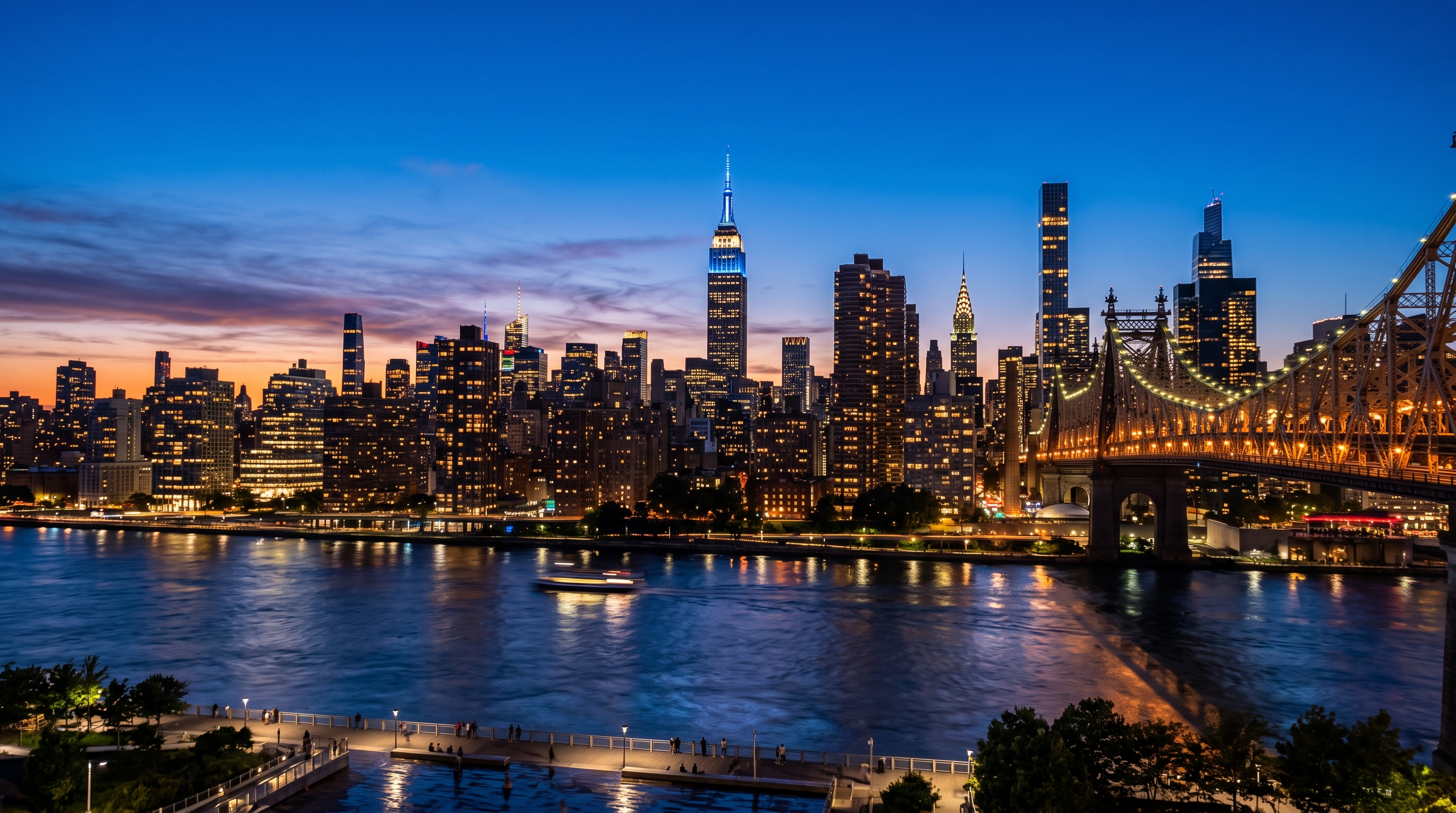
New York does not hand you one walkable cluster. Hudson Yards holds the Javits Center on the far West Side, the convention anchor of the whole calendar. Midtown Manhattan stacks Madison Square Garden on Penn Station, Radio City, and the Broadway and hotel-ballroom corporate work. The Upper West Side carries Lincoln Center's galas and performing-arts nights, Downtown Brooklyn runs Barclays Center and its own activation scene, and Long Island City in Queens adds studio, warehouse, and brand-launch space across the river. Each is its own node with its own access, so a full week is several separate orders, not one crew walking between rooms.
The Javits floor sets the tone, and it is a union house. Carpenters own booth build, pipe and drape, and signage; Teamsters own freight and rigging; an exhibitor's own hired crew is scoped to registration, guest services, ambassadors, and hosting. We size to the doors you actually control and back the call times off the West Side dock schedule. Everywhere else the constraint is the same in a different form: no crew parks at the Garden, the subway is the loading plan, and a call time is set to the train, not the marquee.
"In New York the roster fills itself. What you are really buying is someone who knows which door, which dock, which union, and which train."Megan Hayward, Founder & CEO, TempGuru
Venue and logistics notes
Javits Center, Hudson Yards. About 3.3 million square feet on the far West Side, freight metered through the docks and the floor under Carpenter and Teamster jurisdiction. Scope your crew to registration, guest services, and ambassadors, and phase call times against the truck schedule, not the show-floor open.
Madison Square Garden, Midtown. Roughly 20,000 seats stacked on Penn Station with no dedicated crew parking. The subway and commuter rail are the loading plan, so gate, usher, and hospitality call times are set to transit windows and a screening buffer before doors.
Barclays Center, Downtown Brooklyn. Up to about 19,000 over the Atlantic Terminal hub, a separate borough with its own access. Staff it as its own node with a Brooklyn-based crew instead of pulling a Manhattan pool across the East River at rush hour.
Lincoln Center and the Upper West Side. Gala and performing-arts work where presentation is the standard, campus load-in is tight, and coat, host, and ambassador crews carry the room. Uptown call times run against cross-town traffic, so we route crew by train and stage early.
03What We Staff
Conventions and Fashion Week lead, then the arenas and the galas.
Sort a New York calendar by volume and the conventions and trade shows at the Javits Center sit on top, drawing registration, badge, and guest-services crews against a union floor. Close behind is the range that makes New York its own market: brand activations and Fashion Week, where a February window and year-round Manhattan pop-ups want ambassadors who can hold a script and read a luxury room.
Sports and concerts come next, with the Garden and Barclays stacking arena nights on both sides of the East River, and Yankee Stadium and Citi Field adding open-air dates in the Bronx and Queens. Then the corporate and gala calendar fills the Midtown hotel ballrooms and Lincoln Center, and festivals and outdoor events push crowd and gate crews into the parks and the waterfront. Across all of it the roles are the ones an outside crew can own: check-in, hosting, wayfinding, ushering, and hospitality.
04The Math
Scope the crew to the doors you actually control.
Read the roster like a floor plan: 14 at registration for the arrival window, 3 leads splitting the exhibit floor at about 11 each out of 35 billable. A floater covers the surge so nobody stands idle at a loading dock.
05The Clock
Fashion Week and the show calendar claim the pool first.
Book early and you lock the crew and the rate. New York peaks in waves rather than one season: the Javits show calendar runs heavy fall through spring, Fashion Week spikes the credentialed pool every February and September, and the Garden, Barclays, and the ballrooms stack holiday and gala dates into December. When a marquee show or Fashion Week lands, the pool commits early citywide.
06The Rate
One rate per role, already at the downstate floor.
You ask for a role and one number comes back, not a stack of vendor quotes to reconcile. Workers' comp, general liability, payroll taxes, and the spread-of-hours premium already sit inside it, and it is priced to the $17.00 downstate wage floor that covers the five boroughs. New York City's own floor is a dollar above the $16.00 rest-of-state figure, and every rate on this page starts well above either number, so the crew you approve is the crew that works and the crew that bills.
| Role | Rate | Min shift |
|---|---|---|
| General labor / setup | $43–$49/hr | 4 hrs |
| Registration / credentials | $43–$49/hr | 4 hrs |
| Load-in / freight support | $43–$49/hr | 4 hrs |
| Ushers / crowd control | $43–$49/hr | 4 hrs |
| Team leads / supervisors | $53–$59/hr | 4 hrs |
| Brand ambassadors | $59.50–$66.50/hr | 4 hrs |
| Specialty (bartenders, AV) | $63.50–$79.50/hr | 4 hrs |
New York City minimum wage is $17.00/hr. Every worker on this page is W-2, not 1099.
Rate basis: the TempGuru State of Event Staffing 2026 index, 345 markets.
07The Fine Print
A 1099 roster does not dodge the spread-of-hours hour.
In New York, the expensive shortcut is paying event staff as 1099 contractors: back taxes, penalties, and joint-employer liability under federal FLSA and New York Workers' Compensation Law (WCL Article 2). New York adds a spread-of-hours hour: whenever the span from a worker's first task to their last runs past 10 hours in a day, meal breaks and gaps included, the day owes one extra hour at the state basic minimum wage on top of everything else. A Javits move-in that starts at a 6 a.m. dock call and releases after an evening reset clears that 10-hour spread on its own, so the add-on is written into the bill rate up front rather than surfacing as a line item after the show. Inside the five boroughs every hour also prices to the $17.00 downstate wage floor, above the $16.00 rest-of-state figure.
TempGuru runs every worker as a W-2 employee through a vetted partner agency that acts as the employer of record, carrying the workers' comp, general liability, and payroll taxes on each one. Classification and payroll responsibility sits with that employing agency; your own obligations can still depend on how you direct the work and on applicable law. As W-2 employees, the crew also fall under the workplace protections, including New York State Human Rights Law, that apply to the agency's other staff.
- W-2 employment, not 1099
- Workers' compensation insurance
- General liability coverage
- Payroll taxes: FICA, FUTA, SUTA
08The Model
One coordinator holding five boroughs and a union floor.
You talk to one coordinator. Behind them, TempGuru pulls vetted W-2 crews from a roster of partner agencies and holds the relationships and the paperwork.
One coordinator, one crew, one invoice. When a Javits dock window slips and the Garden call has to move to a different train line the same afternoon, you reach one coordinator, and the borough map, the union scope, and the transit timing were already worked before you asked.
| The moment | Gig app | TempGuru |
|---|---|---|
| Someone no-shows at 6 a.m. | A support ticket | A coordinator with a name |
| Workers’ comp | Check the fine print | In the rate |
| Classification & payroll | Yours to sort out | The partner agency’s, as employer of record |
The difference shows up at 6 a.m., not in the demo.
09A Sample Plan
An illustrative staffing order.
The clearest New York example is a Javits move-in. Picture a national trade show taking the expanded halls for four days, around forty thousand attendees once the floor opens, but the exhibitor-side plan is deliberately narrow because the floor is a union house. Fourteen on registration open the badge halls at the main and river-side entrances from six-thirty, eight on guest services point a crowd across concourses that run the length of the building, and six ambassadors and four on hospitality carry the sponsor booths and the VIP lounge.
Three leads hold it, one to a hall, radioed back to the dock and the show office. Thirty-five billable people over four days, booked as one order and run off a single coordinator's sheet, with booth build and freight left to the Carpenters and Teamsters who own that work. The scope is the whole point here: you staff the doors you control, phased against the truck schedule, and let the house floor handle its own.
10Your Move
Five boroughs, one order, one invoice.
A cheaper name is easy to find in a city this size. Harder to find is a Javits move-in staffed W-2 around the house unions, a Garden call timed to the subway instead of a parking lot, and a Brooklyn date run as its own order, all held by one coordinator who had the dock windows and the borough map before the first truck reached the West Side. That is the order we take.
(904) 206-8953 is TempGuru's national staffing desk. Every city, including New York City, runs through it.
New York City Event Staffing FAQs
How much does event staffing cost in New York City?
Can my own crew build booths on the Javits Center floor in New York City?
How fast can I get event staff in New York City?
Are the crews W-2 or 1099 in New York City?
How do the five boroughs change a New York City staffing plan?
When is the busy season for events in New York City?
Sources & methodology · verified July 2026
- Min Wage · dol.ny.gov
- Min Wage · lawandtheworkplace.com
- Workers Comp Law · wcb.ny.gov
- Javits Center · javitscenter.com
- Javits Union Jurisdiction · icff.com
- Madison Square Garden · en.wikipedia.org
- Barclays Center · en.wikipedia.org
- Lincoln Center · lincolncenter.org
- Fashion Week · cfda.com
Venue capacities, wage floors, statutes, and event dates for New York City are verified against the official sources above. Rate ranges derive from the TempGuru State of Event Staffing 2026 index.
