
Washington Event Staffing
TempGuru · Washington, DC · Updated July 2026
Crews for the association, summit, and inaugural calendar that fills the nation's capital, cleared through background checks and badging before they reach a secured floor.
Scroll. It gets specific.01The Ground Truth
Washington, D.C. fills its halls with associations and summits. Security clearance, not headcount, is the gate.
National associations hold their annual meetings here, advocacy groups run fly-ins on the Hill, and policy shops pack the Walter E. Washington Convention Center with summits and forums. Filling the seats is the easy part. The work is moving a vetted, badge-cleared crew past the magnetometers and onto a secured floor before the first session, and the federal-adjacent dates push that clearance bar higher than almost any other market.
Quick Answer
In Washington, D.C., budget $33 to $39 an hour for the bulk of event roles, $43 to $49 for supervisors, and $49.50 to $69.50 for credentialed specialty work like bartenders, AV, and brand ambassadors. Each figure is one all-in W-2 number that already absorbs workers' comp, general liability, and payroll tax.
A single coordinator owns the order from first call to load-out. A placed order is confirmed inside a 24 to 48 hour window, same-day fills are possible when a booking breaks late, and most planned work sits on a two-to-four-week runway. Federal-adjacent dates want a longer head start, because the background-check and badging queue sets the real clock.
Teams that booked TempGuru, in their own words

The staff we had onsite were amazing. They were polite, professional, and always willing to help. They made a meaningful impact on the success of our event.

Both staff were well suited for our event needs and were keen to help in any way possible.

You delivered excellent service from the very first contact, and Emmanuel was also great during the installation: very attentive, knowledgeable about the subject, and my team praised him highly.

02The Map
A compact core, a waterfront, and a security perimeter that sets every call time.
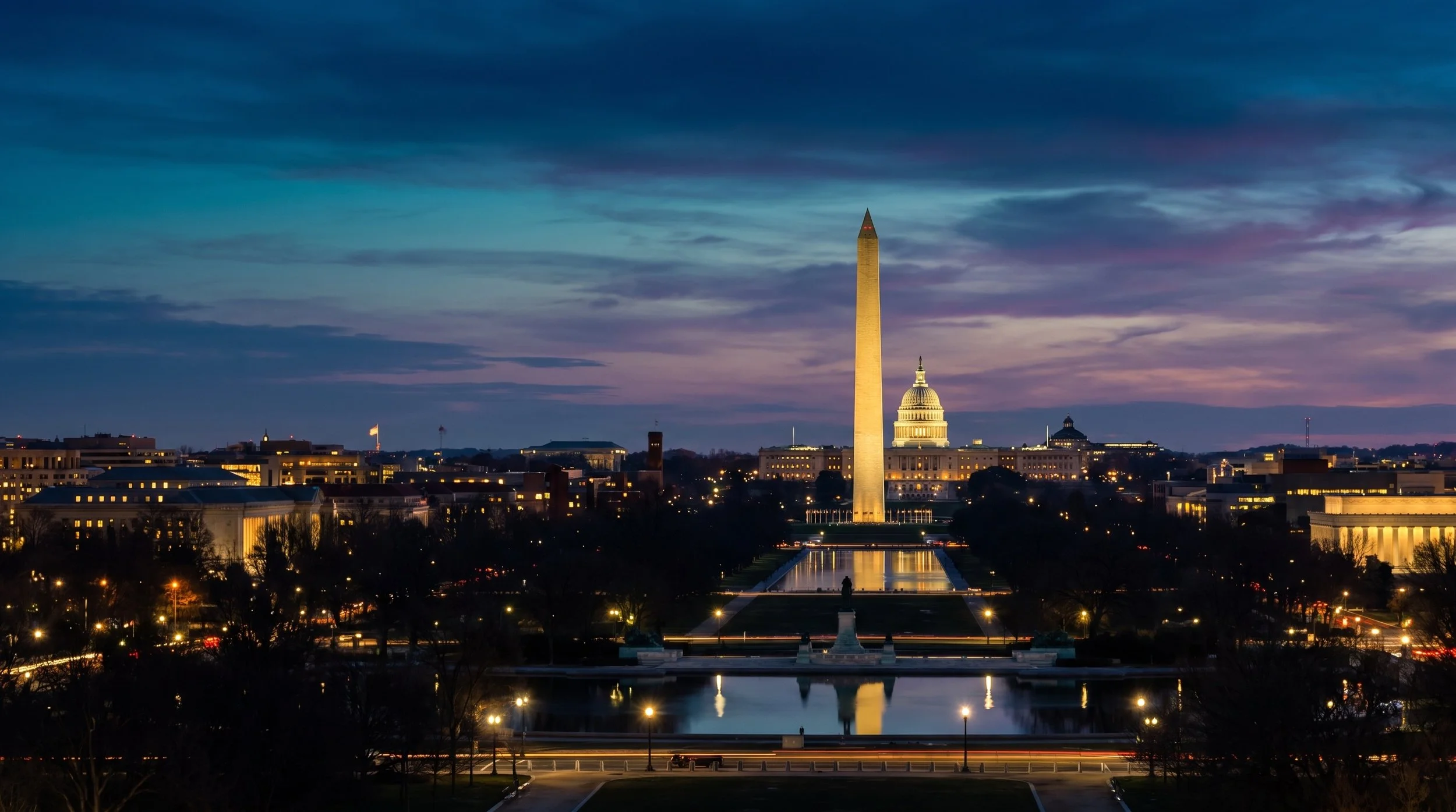
The map is small and the security is not. Downtown, in Penn Quarter, holds the Walter E. Washington Convention Center, with Capital One Arena a short walk away, so an association general session and an arena crowd can land the same evening off one Metro platform. Southwest, along the Washington Channel, The Wharf keeps its own schedule around The Anthem. Down on the Anacostia, Navy Yard puts Nationals Park and, a few minutes over at Buzzard Point, Audi Field into the same southeastern pocket of the city.
Getting there is rarely the problem. The Metro reaches every one of these venues, and nothing here is a highway haul. Access is. A federal-adjacent event runs credentialed entry, magnetometer screening, and a bag-check line, while a motorcade, a demonstration, or a Secret Service perimeter can shut a block on short notice and rewrite the load-in window. So the call sheet is planned backward from the screening queue and the closure map, and every worker on it has cleared a background check before showing up.
"The venues here sit minutes apart. What sets the call time is the badge line and the security perimeter, never the drive."Megan Hayward, Founder & CEO, TempGuru
Venue and logistics notes
Walter E. Washington Convention Center, Penn Quarter. More than two million square feet of association and trade-show floor. Freight moves through the loading docks early, and the registration and floor teams stage to the badge-issuance window rather than the clock on the wall.
Capital One Arena, Penn Quarter. A downtown arena steps from the Convention Center. Event gates screen with magnetometers and bag checks, so plan a screening cushion ahead of the crowd and post crew off the Metro instead of a garage.
Nationals Park and Audi Field, the Anacostia waterfront. Baseball at Navy Yard, soccer a few minutes over at Buzzard Point, close enough to share a night. Both sit behind controlled lots and event-day street closures, so send crew down the Green Line before first pitch and kickoff, not into the road grid.
The Anthem, The Wharf. A Southwest Waterfront concert hall with a tight load path off the promenade. Late calls, a packed Wharf, and almost no on-site parking keep the crew on transit and on early report times.
03What We Staff
The association calendar sets the pace. The venues and the government fill the rest.
Line up a year of D.C. bookings and the association world sits on top. Conventions, trade shows, and advocacy fly-ins take the Convention Center's busiest weeks and spill into hotel ballrooms across downtown, each one wanting badge desks, floor teams, and freight hands. Galas and policy summits follow close behind, the black-tie dinners, award nights, and think-tank forums that live or die on a check-in line, a coat room, and a floor read right.
After that the calendar turns local. Arena sports and concerts at Capital One Arena, Nationals Park, and Audi Field bring the scanner crews, ushers, and entry lines a sold gate depends on. Government and contractor events handle the receptions, briefings, and awards for the agencies and firms based here, and brand activations put trained ambassadors on the National Mall or along The Wharf.
04The Math
The roster starts at the badge line.
33 billable, staggered by arrival window: 11 handle setup and load-in, 9 handle registration, and 3 leads oversee about 10 each. No one clocks in before there's work to do.
05The Clock
Book before the background-check window closes.
Book early and you lock the crew and the rate. Demand in Washington, D.C. climbs every spring and fall with the association and gala season, then spikes on a schedule of its own: an inauguration every four years, the IMF and World Bank meetings, and the summit weeks that book the Convention Center months out.
06The Rate
One all-in rate per role, with D.C.'s minimum wage already inside it.
Each role is quoted as a single bill rate, so you are not stitching a budget together from three vendors. That number already carries workers' comp, general liability, and payroll tax, which means the figure you sign off on is the figure you pay. D.C. runs the region's steepest minimum wage at $18.40 an hour, and it sits beneath these all-in rates rather than stacking on top.
| Role | Rate | Min shift |
|---|---|---|
| General labor / setup | $33–$39/hr | 4 hrs |
| Registration | $33–$39/hr | 4 hrs |
| Warehouse / logistics | $33–$39/hr | 4 hrs |
| Crowd control / ushers | $33–$39/hr | 4 hrs |
| Team leads / supervisors | $43–$49/hr | 4 hrs |
| Specialized (bar, AV, ambassadors) | $49.50–$69.50/hr | 4 hrs |
District of Columbia minimum wage is $18.40/hr. Every worker on this page is W-2, not 1099.
Rate basis: the TempGuru State of Event Staffing 2026 index, 345 markets.
07The Fine Print
A 1099 roster is the wrong bet in a credentialed city.
In District of Columbia, the expensive shortcut is paying event staff as 1099 contractors: back taxes, penalties, and joint-employer liability under federal FLSA and District of Columbia workers' compensation law.
TempGuru runs every worker as a W-2 employee through a vetted partner agency that acts as the employer of record, carrying the workers' comp, general liability, and payroll taxes on each one. Classification and payroll responsibility sits with that employing agency; your own obligations can still depend on how you direct the work and on applicable law. As W-2 employees, the crew also fall under the workplace protections, including federal Title VII, that apply to the agency's other staff.
- W-2 employment, not 1099
- Workers' compensation insurance
- General liability coverage
- Payroll taxes: FICA, FUTA, SUTA
08The Model
One coordinator holds every credential.
You talk to one coordinator. Behind them, TempGuru pulls vetted W-2 crews from a roster of partner agencies and holds the relationships and the paperwork.
One coordinator, one crew, one invoice. A Secret Service closure drops around the Convention Center before dawn and the magnetometer line is already snaking down the block. You make one call, and the crew you booked cleared their background checks a week back and picked up badges yesterday.
| The moment | Gig app | TempGuru |
|---|---|---|
| Someone no-shows at 6 a.m. | A support ticket | A coordinator with a name |
| Workers’ comp | Check the fine print | In the rate |
| Classification & payroll | Yours to sort out | The partner agency’s, as employer of record |
The difference shows up at 6 a.m., not in the demo.
09A Sample Plan
An illustrative staffing order.
Take a live example: an international affairs summit holding two halls of the Walter E. Washington Convention Center over three days, five thousand delegates in from around the world. The day is built around the security gate. Load-in and freight report at half past five to raise booths on a quiet dock. The credential desk opens at six-thirty to issue badges against the access roster, a screening line comes up beside it for magnetometers and bag checks, and by seven-thirty wayfinding staff take the session doors. Three leads run a hall each across twelve-hour shifts.
Credentialing is the spine of the whole plan. Not one of the 33 reaches the floor without a background check on file and a badge pulled that morning, because a federal-adjacent summit will not seat an unvetted crew. That is 33 billable people on a single invoice, and a coordinator who filed the badge roster a week ahead so nobody stalls at the magnetometer while a session waits.
10Your Move
Your summit. Our crew, badged and on time.
You can find a lower number. What you cannot find at that number is a background-checked, badge-ready crew that clears a federal perimeter, works W-2 from the first shift, and answers to one coordinator running your D.C. event start to finish. That is the work we sign up for.
(904) 206-8953 is TempGuru's national staffing desk. Every city, including Washington, runs through it.
Washington Event Staffing FAQs
How much does event staffing cost in Washington, D.C.?
How fast can I get staff in Washington, D.C.?
Are workers W-2 or 1099?
Do D.C. events really need credentialed, background-checked crew?
When is the busy season?
What can TempGuru staff here?
Is TempGuru an event staffing agency in Washington, D.C.?
What is event staffing?
Sources & methodology · verified July 2026
- Min Wage · does.dc.gov
- Workers Comp Law · code.dccouncil.gov
- Walter Washington Convention · eventsdc.com
- Convention Dock Split · eventsdc.com
- Capital One Arena · capitalonearena.com
- Capital One Renovation · capitalonearena.com
- Nationals Park · mlb.com
- Audi Field · dmped.dc.gov
- The Anthem · theanthemdc.com
- B20 Summit · uschamber.com
Venue capacities, wage floors, statutes, and event dates for Washington are verified against the official sources above. Rate ranges derive from the TempGuru State of Event Staffing 2026 index.
